Pulmonary Embolism Risk Stratification from CTPA and Medical Records: Vascular Graphs Are Not All You Need
Sep 24, 2026· ,,,,,,,,·
0 min read
,,,,,,,,·
0 min read
Nathan Painchaud
Tristan Habémont
Morgane Des Ligneris
Allan Serva
Pierre Croisille
Laurent Bertoletti
Thomas Lampert
Johannes F. Lutzeyer
Odyssée Merveille
Abstract
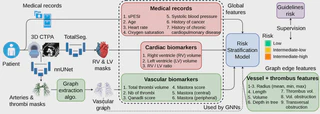
Risk stratification for pulmonary embolism (PE) is critical for clinical decision-making. Stratification guidelines are based on patient medical records, parameters measured from computed tomography pulmonary angiography (CTPA), and blood tests. However, blood tests are often missing in routine practice. This work studies whether state-of-the-art models can accurately classify risk stratification from only medical records and biomarkers extracted from CTPA images. We benchmark different approaches to combine medical records and cardiac biomarkers with rich pulmonary vascular information; we add vascular biomarkers to tabular models and apply graph neural networks (GNNs) on the vascular tree’s intrinsic graph representation. We use a private dataset (n=353) with uniquely complete data for PE risk stratification. Our results show that, among global features, medical records and cardiac biomarkers are the most significant predictors, while vascular biomarkers do not further improve stratification. Even more surprising, even GNNs on vascular graphs fail to outperform strong tabular baseline on global features. We consider hypotheses, on both models and data, that could explain this suboptimal performance. Our investigation suggests that, counter-intuitively, vascular graphs may not help predict PE guidelines risk better than simpler clinical biomarkers. Code is available from https://github.com/creatis-myriad/GENESIS.
Type
Publication
in proc. Medical Image Computing and Computer Assisted Intervention (MICCAI)
